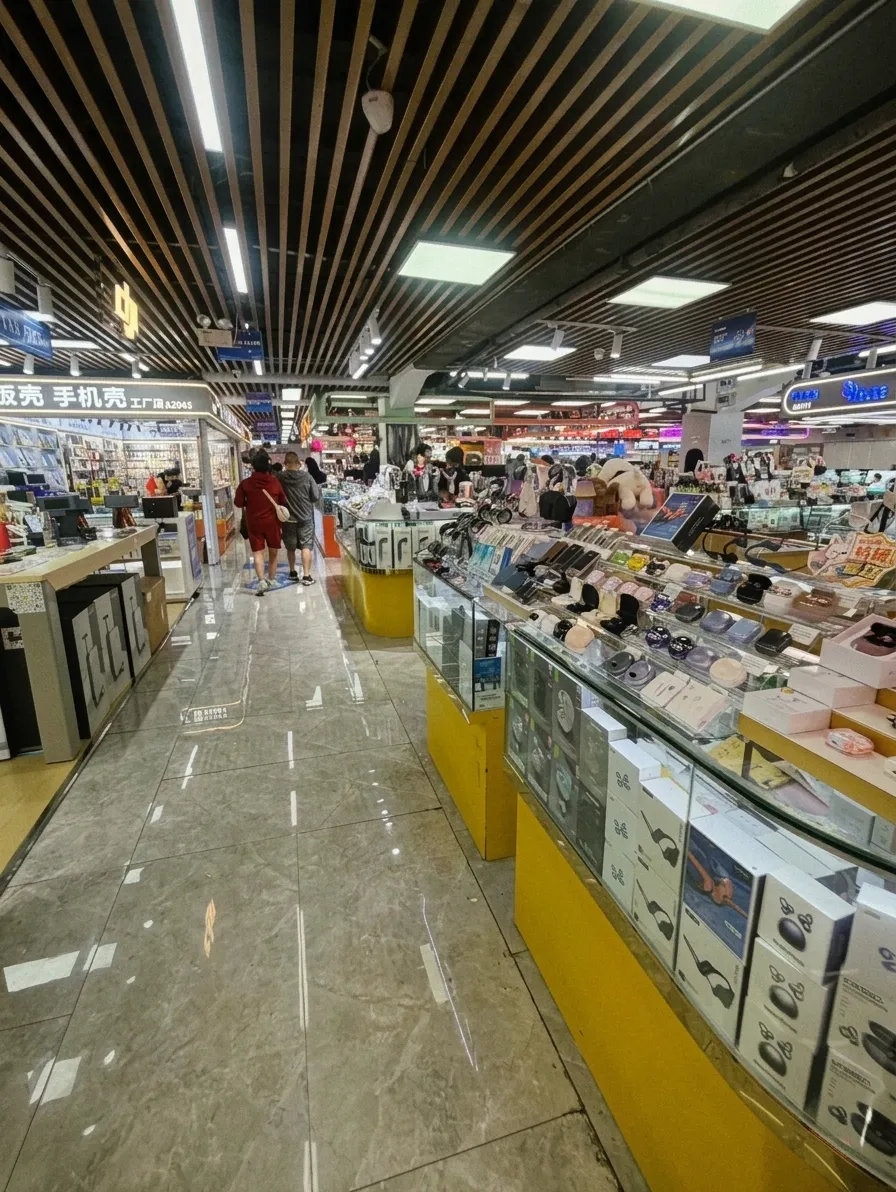
My first day in Shenzhen was also the first real day of my trip. After a long journey from Amsterdam to Xiamen and a missed train to Shenzhen, I arrived at three in the morning. A few hours later I was up again, heading for the electronics malls of Futian District, like the Yuanwang Digital Mall.
They're overwhelming. Floor after floor of gadgets, cables and things you didn't know existed. I didn't know where to look. And from every corner: "Do you need something? Good quality, good price."
I'm used to haggling in euros, not in a currency I don't know. So I looked for something small to practise on, with a simple currency app in my hand. Every new price meant typing it in again: what the seller asked, and what I actually wanted to pay.
At a phone case stall, a friendly man offered me a sweet and told me to take a look around. That made me want to see what he had. I picked a case and asked the price: ¥50. Quite a lot for a phone case, especially straight from a factory shop. ¥20 felt fairer. Not because I begrudged him the sale, but because I wanted to pay a realistic price. We went back and forth, and in the end I got it for a good price.
I walked away with a nice case, but mostly I now knew what to expect. With that in mind I went through more malls and bought earbuds, a laptop case and a mini camera. Not dirt cheap, but cheaper than at home.
I didn't have the idea for Hagglr yet, let alone the name. But I noticed how often I opened that currency app. It only converted currencies, so every new offer meant typing, deleting and typing again. The free version also kept showing ads in between. What I really missed was a way to keep the seller's price and my offer side by side while haggling. So that evening, back at my room, I opened my laptop and built a prototype. Not perfect, but it worked. Ten steps became a few.
That was the start of Hagglr. I just didn't know yet how much it would grow.